
...
...
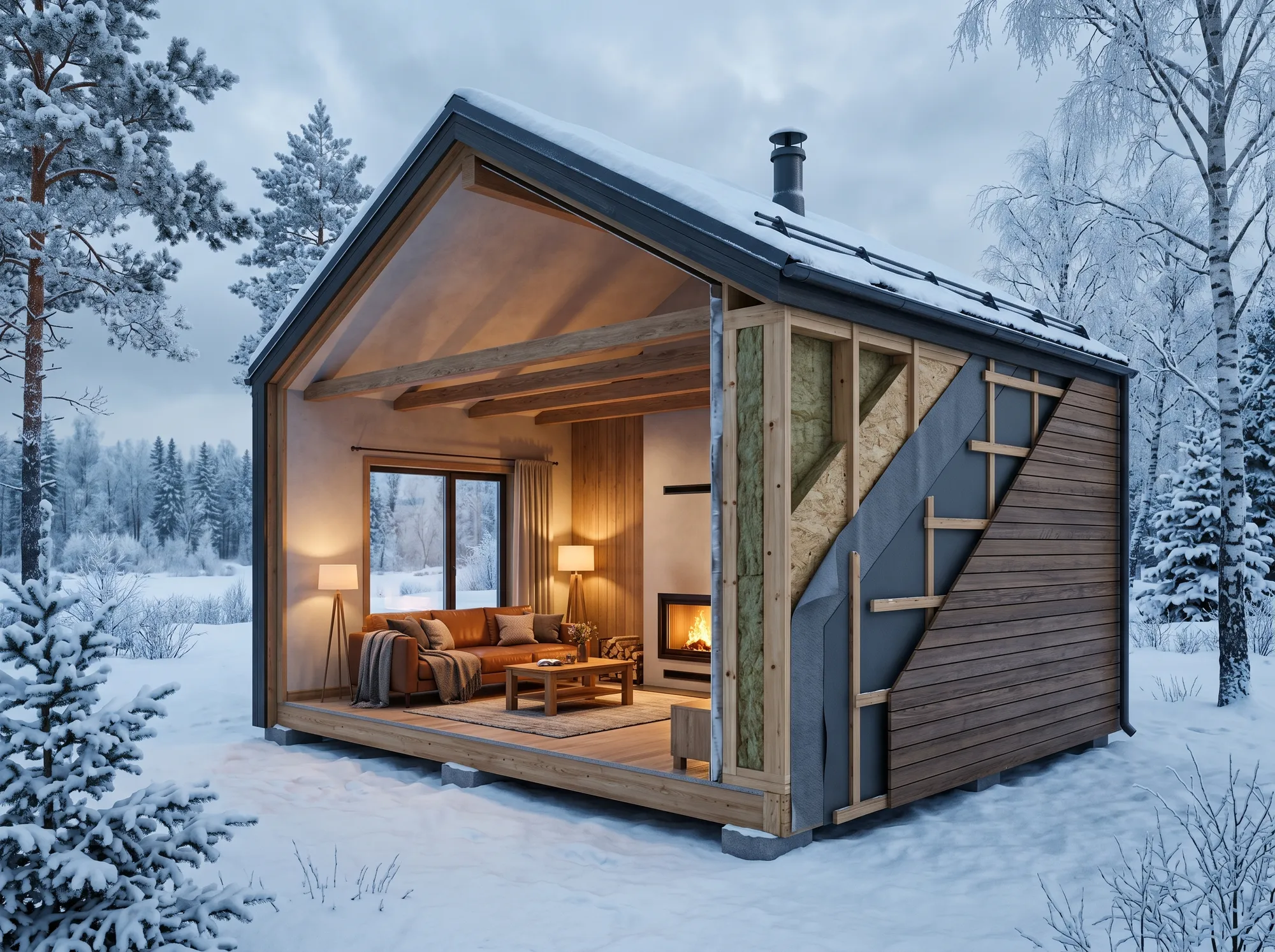
A timber frame house is essentially a thermos. Its thermal performance is defined almost entirely by the insulation and how correctly the wall assembly is built. In the Leningrad Region (−26 °C design temperature, 220+ day heating season) insulation mistakes are expensive — wasted fuel, cold bridges, condensation and mould.
The most popular for frame walls. Brands: Rockwool, Paroc, Tekhnonikol. Thermal conductivity 0.035–0.042 W/(m·K), non-combustible, vapour-open, density 30–50 kg/m³ for walls. Loses performance when wet — needs internal vapour barrier and external windproof membrane.
Blown-in cellulose with borate fire retardants. 0.037–0.042 W/(m·K), seamless fill, good acoustics. Settles 10–15% over time (dry blow); needs specialist equipment.
Premium. 0.022–0.025 W/(m·K) — nearly twice as effective as mineral wool. 80 mm PIR = 150 mm wool. Non-absorbent. 3–4× more expensive; often used as an extra outer layer over the studs to break thermal bridging.
Not recommended for frame walls. Vapour-tight — traps moisture; in 2–3 years the frame rots. OK for floors, plinth and foundation only.
Internal lining — GKL 12.5 mm or tongue-and-groove on battens (service cavity)
Vapour barrier — film (Izospan B, Delta Reflex) on the warm side, taped, overlap ≥150 mm
Insulation — basalt wool 200 mm in 2 × 100 mm layers with staggered joints
External sheathing — OSB-3 9–12 mm or cement-bonded board
Wind/moisture membrane — vapour-open (Izospan A, Tyvek, Delta Vent N), NOT another vapour barrier
Ventilation gap — 20–40 mm battens, carries moisture upward
Cladding — siding, plank, planken
Required R = 3.08 m²·K/W (SP 50.13330.2012, HDD ~4800).
Layer | Thickness, mm | λ, W/(m·K) | R, m²·K/W |
|---|---|---|---|
GKL | 12.5 | 0.21 | 0.06 |
Vapour barrier | — | — | — |
Basalt wool | 200 | 0.038 | 5.26 |
OSB-3 | 12 | 0.13 | 0.09 |
Vent gap | 30 | — | — |
Siding | 10 | — | — |
Total | ~5.4 |
5.4 significantly exceeds the 3.08 requirement — real efficiency, not bare compliance. With 150 mm wool R≈4.0 — also passes but with less margin.
Vapour barrier on the outside instead of windproof membrane — frame rots in 2–3 years
Gaps between insulation slabs — 5 mm is already a cold bridge
No ventilation gap — membrane useless
Wrong membrane orientation — reverse effect
Untaped vapour barrier joints — as bad as having none
Material / labour | ₽/m² |
|---|---|
Basalt wool 200 mm (Rockwool / Tekhnonikol) | 600–900 |
Vapour barrier + tape | 80–120 |
Wind/moisture membrane | 70–110 |
OSB-3, 9 mm | 350–500 |
Battens (vent gap) | 100–160 |
Vinyl siding | 400–700 |
GKL 12.5 mm + battens | 300–450 |
Labour | 800–1 400 |
Total per m² | 2 700–4 300 |
For a 100 m² house (120–150 m² of wall) — 320 000–650 000 ₽. PIR instead of wool raises the budget 40–60% but reduces wall thickness.
StroyInvest24 insulates frame houses across the Leningrad Region with strict technology control at every stage — from vapour barrier to final cladding.
Need a consultation on your project? Leave a request: Turnkey frame house construction.
Get in touch — we'll answer all your questions and help you choose.
Leave a request — we'll contact you, clarify details and offer the best solution for your plot and budget.
Response within 30 minutes
+7921-76-76-76-1
info.stroyinvest24@gmail.com
We'll call back and consult for free