
...
...
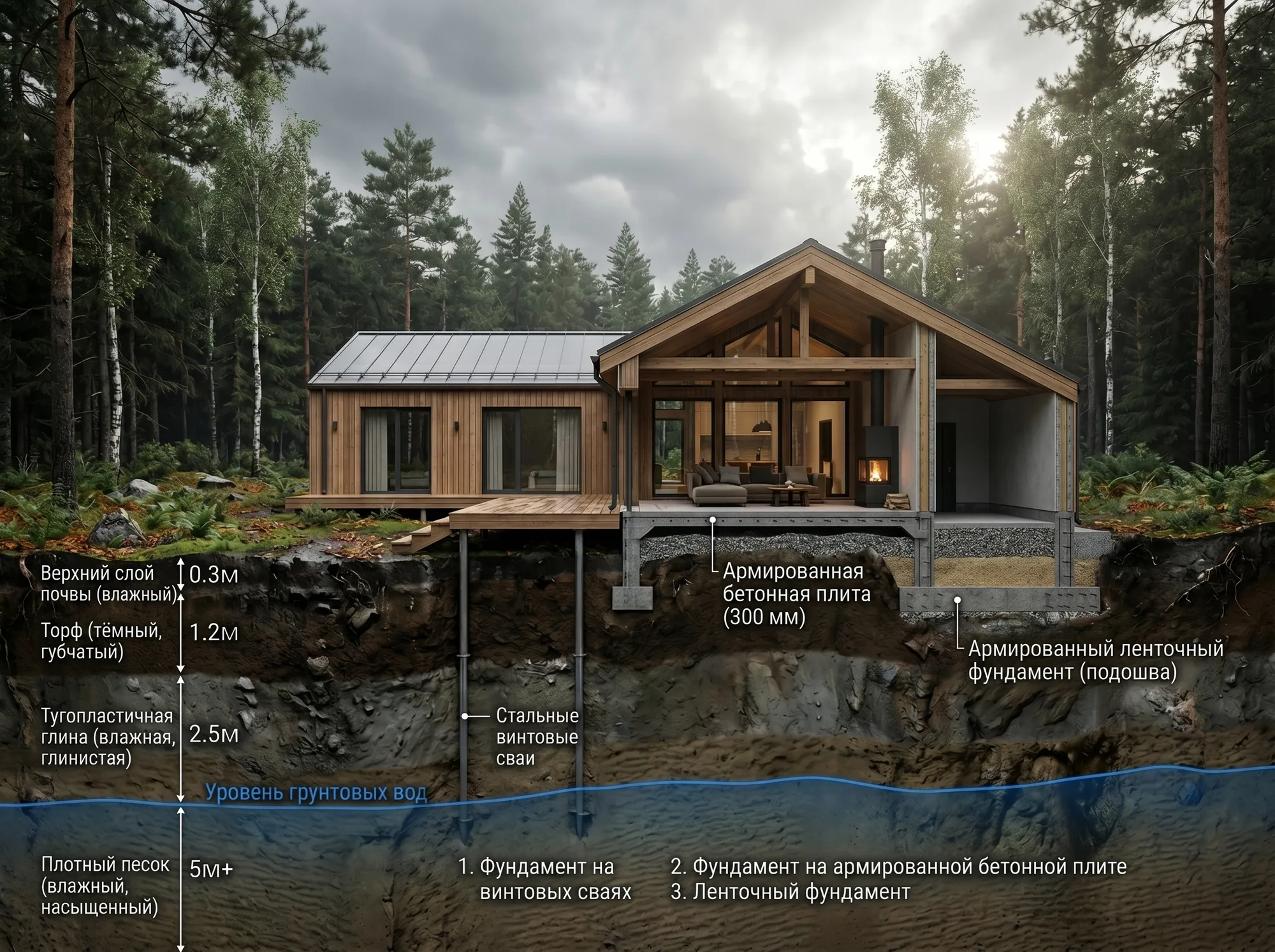
The foundation is the basis of any house, and in the Leningrad Region its selection is especially critical. Complex soils, high groundwater levels, and seasonal frost make the decision far from simple. A mistake at this stage can cost hundreds of thousands of rubles — and in some cases may make the house unsuitable for living.
Let’s break down the main foundation types, their costs, and suitability for local soil conditions.
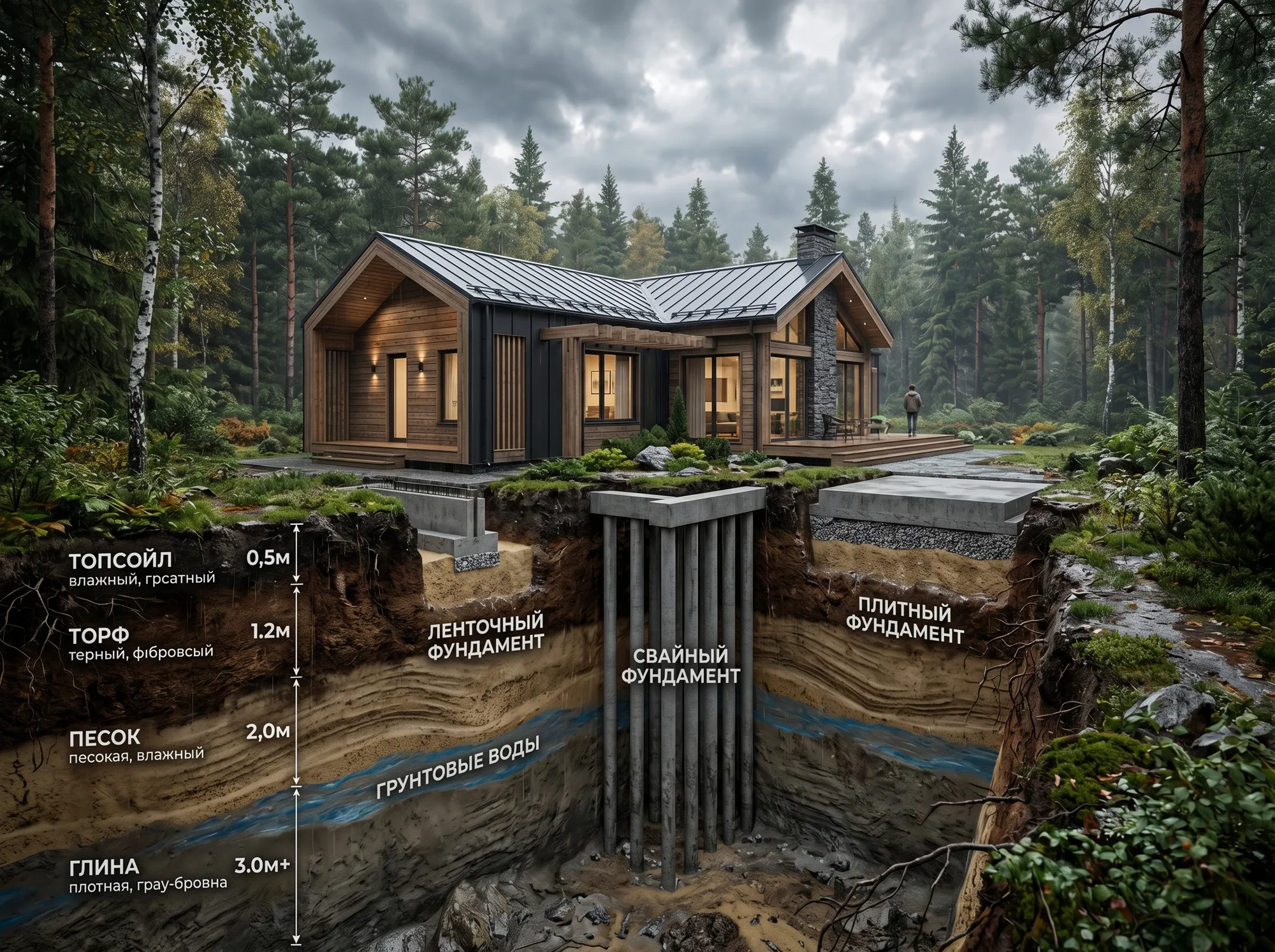
Before choosing a foundation, it is essential to understand the ground conditions of your site. The Leningrad Region has extremely diverse geology — even neighboring plots can differ significantly.
Clay and loam soils
Common in southern and central districts (Gatchina, Tosno, Luga). They are frost-heaving soils and require either deep foundations or compensating engineering solutions.
Sandy and sandy loam soils
Found in Priozersk, Vyborg, and Vsevolozhsk districts. Generally good bearing capacity, but may contain uneven layers causing differential settlement.
Peat and waterlogged soils
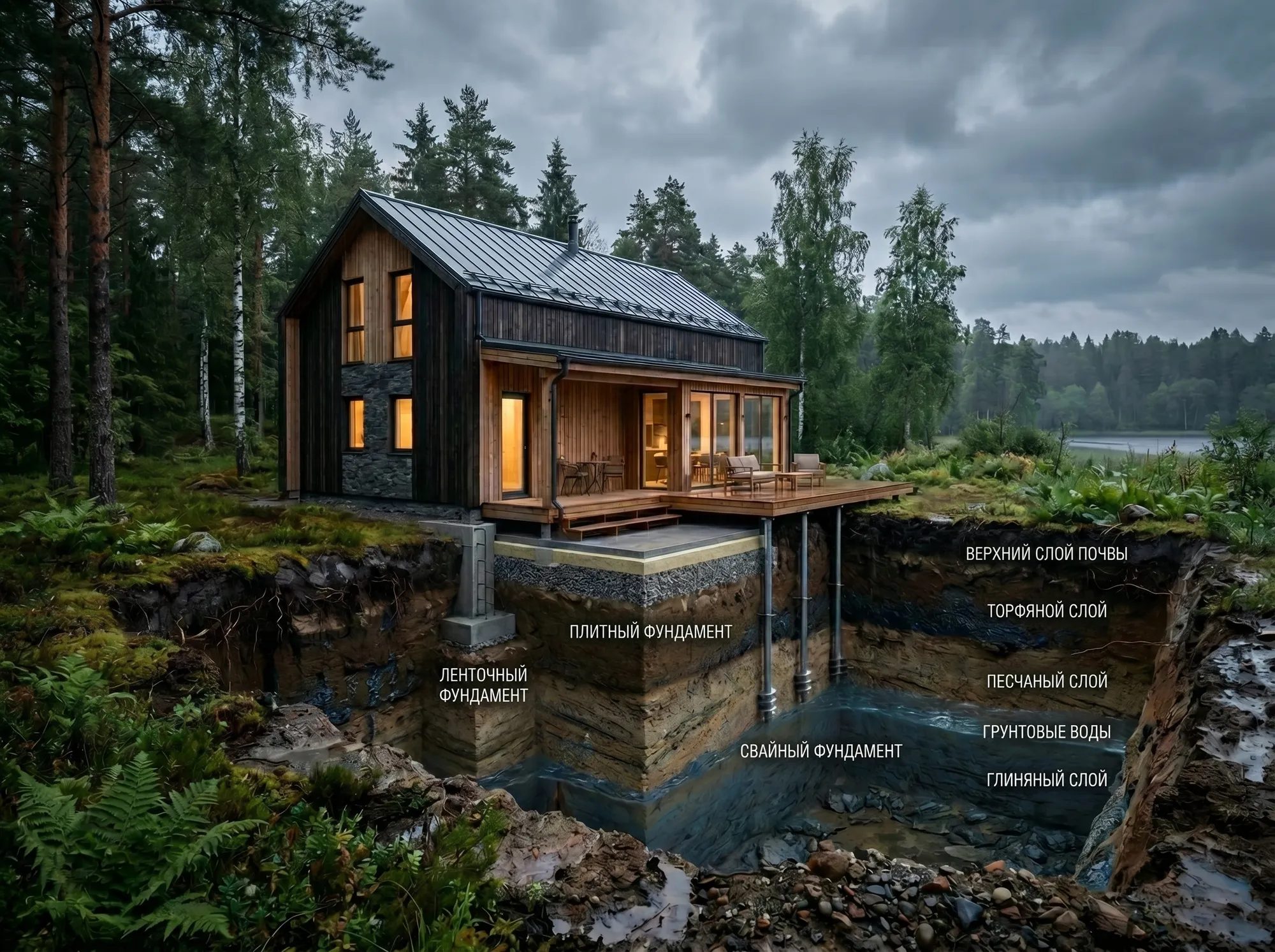
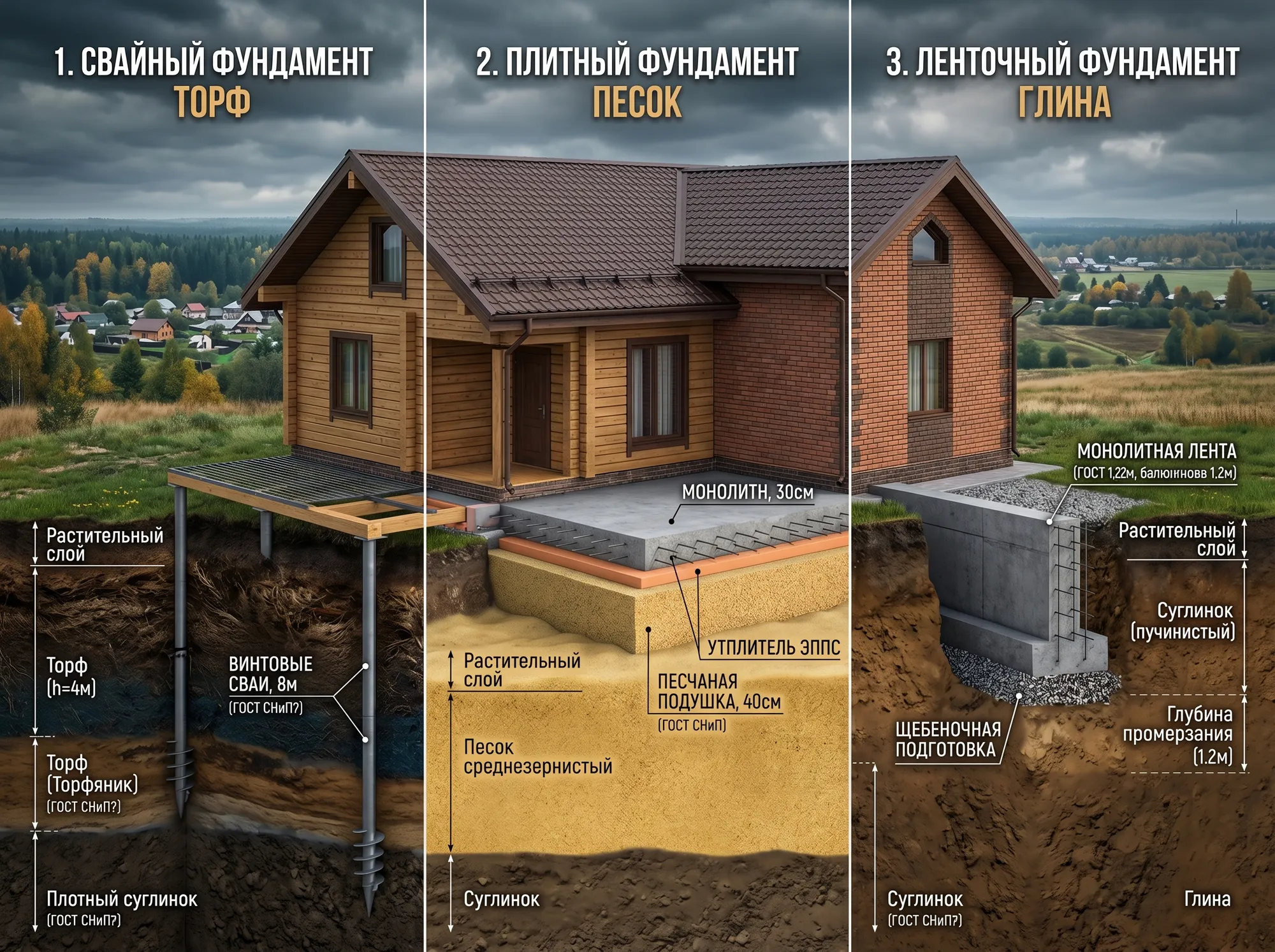
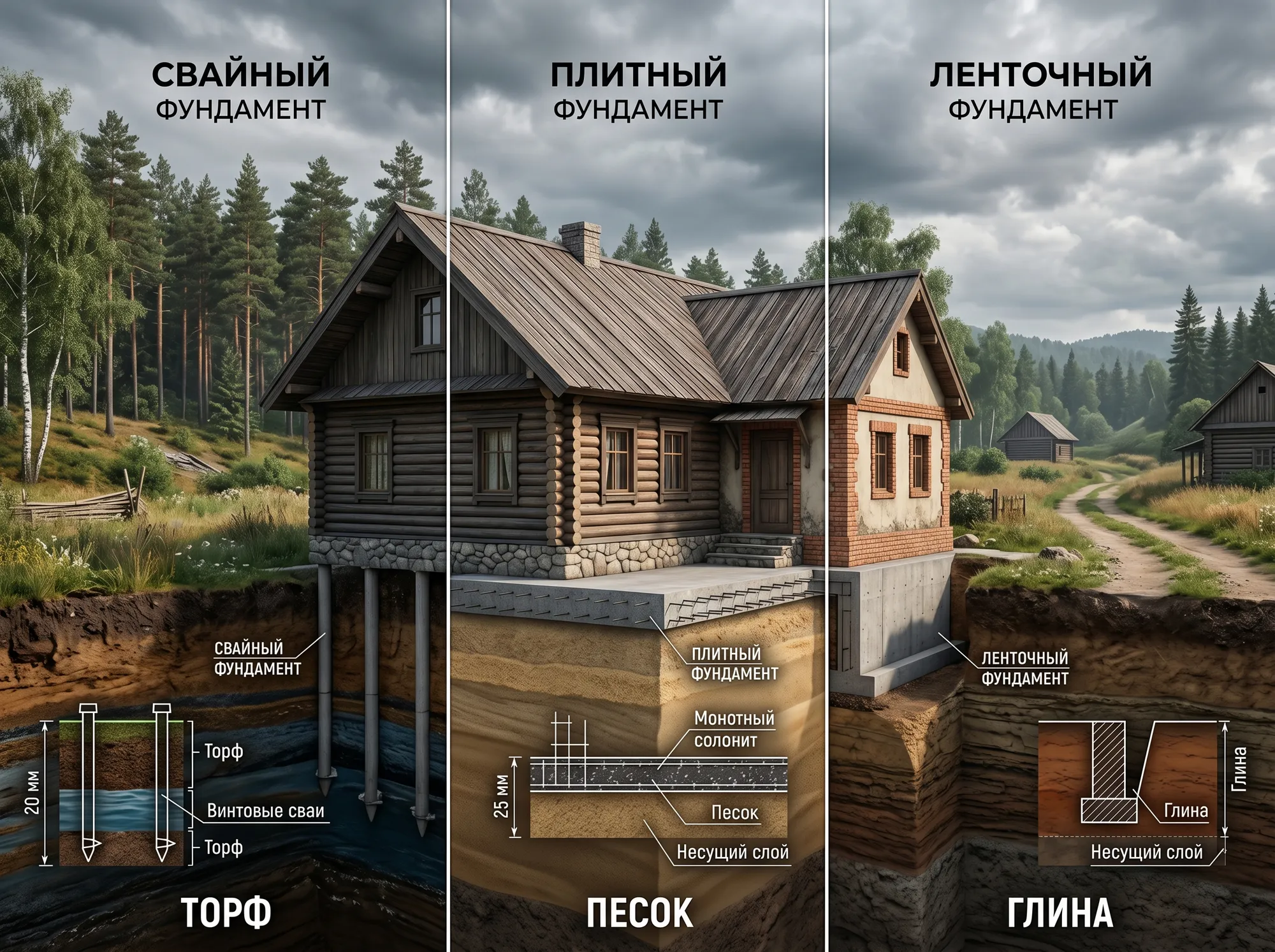
Typical for lowland areas near Lake Ladoga, the Neva Bay, and numerous wetlands. Construction without pile foundations is not recommended.
Glacial deposits (boulder clays)
Found in the Karelian Isthmus. Very dense but difficult for pile installation.
Rock formations
Exposed bedrock in parts of the Vyborg district. Excellent foundation base but requires specialized equipment.
The frost depth in the Leningrad Region ranges from 1.2 to 1.5 meters, depending on soil type and location.
Steel piles with helical blades are screwed into the soil until reaching a load-bearing layer. A grillage (steel beam, timber, or reinforced frame) is installed on top.
Advantages:
Fast installation (1–2 days)
Suitable for peat, wetlands, and sloped sites
Cost-effective
Can be installed year-round
Disadvantages:
Limited load capacity (suitable for frame and timber houses; not for heavy masonry buildings above 1.5 floors)
No basement
Requires insulated crawl space
Risk of corrosion if low-quality piles are used
Best use cases:
Frame or timber houses, peat soils, uneven terrain, limited budgets.
Reinforced concrete strip foundation 40–70 cm deep on a sand cushion, functioning as a “floating” structure.
Advantages:
Suitable for light to medium houses (frame, aerated concrete up to 2 floors)
Moderate cost
Allows for a low crawl space
Disadvantages:
Not suitable for peat or high groundwater levels
Requires drainage and insulated blind area
Seasonal limitations (concreting requires temperatures above +5°C or additives)
Best use cases:
Sandy and sandy loam soils, stable dry plots.
A traditional reinforced concrete strip foundation placed below the frost line (from ~1.5 m).
Advantages:
High load-bearing capacity
Possibility of basement or cellar
Suitable for heavy houses (brick, aerated concrete)
Disadvantages:
High cost due to excavation and concrete volume
Long construction time
Requires waterproofing
Not suitable for peat soils
Best use cases:
Heavy houses, need for a basement, stable clay soils with drainage.
A reinforced concrete slab (25–35 cm) on a sand-gravel base.
Advantages:
Distributes loads evenly
Suitable for weak soils
Serves as a subfloor
High reliability
Disadvantages:
High cost
No basement
Difficult to modify utilities after pouring
Requires a level site
Best use cases:
Weak soils (excluding deep peat), heavy houses without basement.
A monolithic slab with insulation (XPS) and integrated underfloor heating and utilities.
Advantages:
High energy efficiency
Ready-made heated floor system
All utilities integrated
Smooth finished base
Suitable for weak soils
Disadvantages:
Highest cost
Difficult to repair utilities
Requires highly qualified contractors
No basement option
Best use cases:
Energy-efficient homes for permanent residence, weak soils, low heating costs in the long term.
Foundation Type | Cost (RUB) | Installation Time | Load Capacity | Basement |
|---|---|---|---|---|
Screw piles (24 pcs) | 180,000 – 280,000 | 1–2 days | Medium | No |
MZLF | 350,000 – 500,000 | 7–14 days | Medium | No |
Deep strip | 650,000 – 950,000 | 14–21 days | High | Yes |
Monolithic slab | 550,000 – 750,000 | 7–14 days | High | No |
USS / UWB | 700,000 – 1,000,000 | 14–21 days | High | No |
Prices are as of March 2026, including materials and labor. May vary depending on site conditions and logistics.
Sand / sandy loam — all types suitable
Clay / loam — piles, slab, USS recommended
Peat (up to 2 m) — piles only (slab/UWB with restrictions)
Peat (over 2 m) — piles only
High groundwater — piles, slab, USS preferred
Rock — all types possible (piles may be difficult)
Engineering geological surveys cost only 15,000–25,000 RUB, but help to:
Identify soil type and bearing capacity
Determine groundwater level
Detect hidden peat or unstable layers
Choose the correct foundation type and depth
Avoid overspending on oversized foundations
Without geotechnical data, you risk either structural failure or unnecessary overspending of 200,000–400,000 RUB. In the Leningrad Region, skipping geology is the most expensive mistake.
Start with a geotechnical survey
Match foundation type to house technology
Always include drainage in design
Plan utilities before foundation pouring
Specialists of StroyInvest24 provide free consultation on foundation selection based on your site conditions, house design, and budget. We work with all foundation types and can organize turnkey geotechnical surveys.
Need a consultation on your project? Leave a request: Turnkey frame house construction.
Get in touch — we'll answer all your questions and help you choose.
Leave a request — we'll contact you, clarify details and offer the best solution for your plot and budget.
Response within 30 minutes
+7921-76-76-76-1
info.stroyinvest24@gmail.com
We'll call back and consult for free